An accountability record has a strange lifespan. The action it describes lasts a moment: a copilot sent the email, an agent called an API, a model denied the request. The record of that action may need to stay checkable for years. An audit under DORA or a data-handling question under GDPR reaches back past the point where anyone remembers the incident. The record has to outlive the action, and often the software that made it. The gap between how long a signature is safe to trust and how long a record must be trusted is the whole problem here.
Why long-lived records need post-quantum protection now
Today's classical digital signatures, the RSA and elliptic-curve schemes underneath most of the web, rest on math problems that a large enough quantum computer would make cheap to solve. Nobody can tell you the date such a machine arrives, though several people will sell you a conference ticket to hear them guess. For long-lived evidence, the point does not depend on the date.
Consider the threat as "harvest now, forge later." An adversary who wants to alter the history of what an AI system did can copy sealed records today and hold them. If they later gain access to a cryptographically relevant quantum computer, classical signatures made now could be forged after the fact. They need the record today and the capability eventually, and for a record that must hold up for a decade, "eventually" is inside the window you are responsible for. You cannot re-sign the past once it is exposed.
What Athena uses, and why standardized schemes matter
Athena seals records with ML-DSA-65. ML-DSA is a lattice-based digital signature scheme, derived from CRYSTALS-Dilithium and standardized by NIST as FIPS-204; ML-DSA-65 is one of its parameter sets, with a security margin suited to records meant to last. Lattice problems are believed to resist both classical and quantum attack, which is why this family was selected through a public, multi-year evaluation rather than invented in-house by someone clever on a Friday afternoon.
A signature protecting long-lived evidence is the wrong place for a private cryptographic design. Standardized schemes have been analyzed by many independent researchers and have public parameters and test vectors. If the value of a record is that a third party can verify it without trusting us, the scheme underneath had better be one that party already trusts.
How sealing works with the record
A seal is only meaningful if anyone can check it without our help. The record is serialized to its RFC-8785 canonical form, the JSON Canonicalization Scheme, which fixes the details that would otherwise let two byte-different files stand for the same logical record: key ordering, whitespace, number formatting, string escaping. Given the same content, every implementation produces the same canonical bytes. Athena computes a digest over those bytes and produces an ML-DSA-65 signature over it.
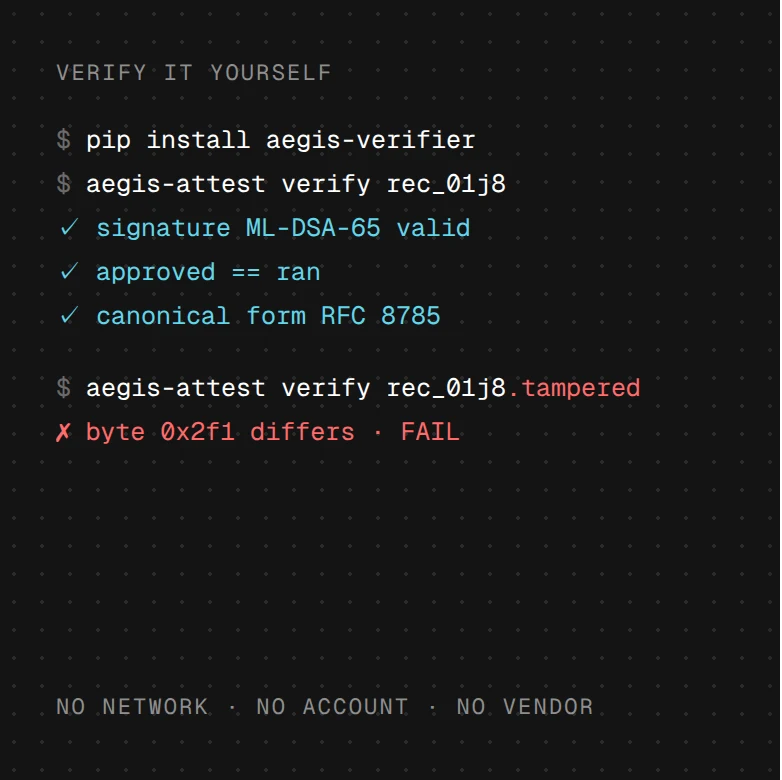
Verification runs the process in reverse and needs nothing from us:
- Take the record and recompute its RFC-8785 canonical form.
- Recompute the digest over those bytes.
- Check the ML-DSA-65 signature against that digest and the public key.
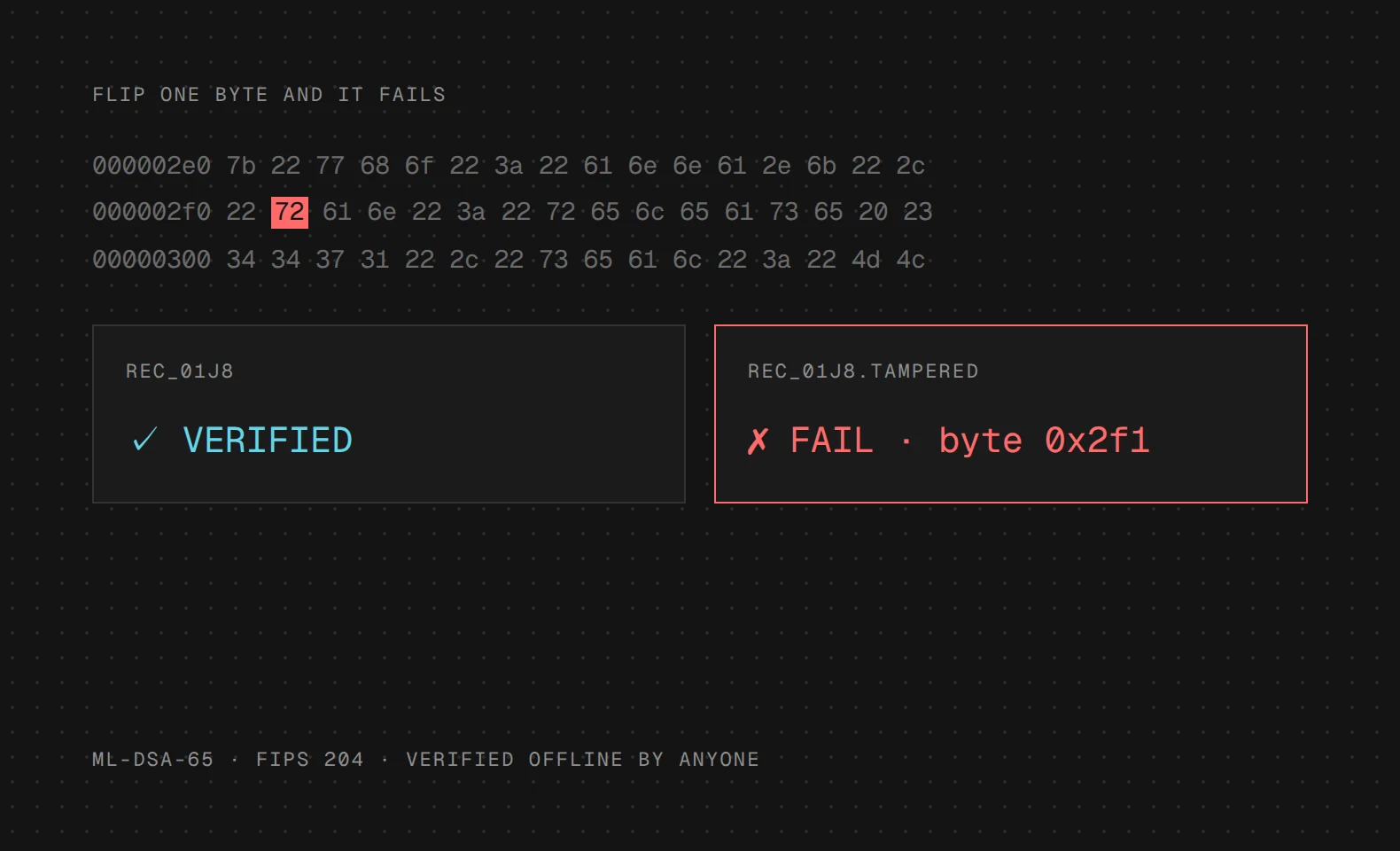
If a single field was altered after sealing, the canonical bytes differ, the digest differs, and the signature no longer verifies. The check is offline and reproducible: given the record, the signature, and the public key, an auditor confirms authorship and integrity on their own machine years later. This is what makes the record tamper-evident. It does not prevent someone editing a copy; it makes any edit visible to anyone who checks.
The honest scope
Post-quantum sealing protects one specific thing: the integrity and authorship of the sealed record over time. It says that this record is the one that was sealed, by the key that sealed it, and that a later forgery attempt, classical or quantum, does not silently succeed. That is a strong property for evidence meant to last, and it is only that.
It is not a claim that the system as a whole is unbreakable, and you will not find the words quantum-proof anywhere on this site. The signature is one control among many. Key management, the security of the runtime, and the correctness of what gets recorded all sit outside the signature and all matter. A perfect signature over a record that was wrong when written is still a faithful seal on a wrong record.
Crypto agility matters too. Standards move and parameter sets get revised, so sealed records carry the scheme and parameters they were made with. A future verifier knows what to check, and new records can move to a new scheme without invalidating the old ones.
Athena produces candidate evidence. We do not issue legal opinions or grant certification, and a seal is a per-record proof, not a transparency log or an attestation about anything beyond the record it covers. What we offer is narrower and more durable than a compliance badge: a record of what your AI did that a third party can still check, and still trust the authorship of, after the action, the software, and possibly the current cryptographic era have all passed.
If you keep records of automated decisions that have to hold up for years, the time to choose a post-quantum signature is when you write the record: you cannot retroactively protect evidence an adversary already holds. Seal over a canonical form with a standardized scheme like ML-DSA-65, keep the scheme recorded so you can migrate later, and you have a record whose authorship a stranger can verify offline long after everyone involved has moved on.