When the AI inside your company, a copilot, a chat tool or an agent, reads a customer record, drafts an email and sends money, something writes that down. Ask what that something is, and most stacks give the same answer: a log. The log says the AI was allowed to act, saw only what it should have, and took the action you approved. It is a clean story. The system wrote it about itself, which is the problem, and also why it reads so well.
What a log actually is
A log is a record a system writes about its own behavior. The application decides what to record, when to record it, and what to leave out. It writes the entry after the fact, in a format it controls, to storage it controls. Read that back and the request it makes of you is simple: trust the writer. The writer, in this case, is the thing under review.
Three properties follow from that, and all three are failure modes when the log is meant to answer for what an agent did.
- Self-authored. The same process that took the action describes the action. If the code has a bug, the log inherits the bug. If the code was tampered with, the log reflects the tampered behavior and calls it normal.
- Mutable. Log lines are rows and files. Anyone with write access to the store, or a later process, can edit, reorder, or delete them, often without leaving a trace inside the log itself.
- Unbound. A log entry that says "action approved" and a separate entry that says "action executed" are two strings near each other in time. Nothing in the log forces the executed action to be the one that was approved. The link is assumed, not proven.
None of this makes logs useless. They are excellent for debugging, and at three in the morning nobody wants a signature, they want a stack trace. They are not evidence, because evidence is the one thing you cannot produce by asking someone to trust your account of yourself.
What makes something proof
Proof is something an independent outsider can check without trusting you. That is the whole distinction, and it has concrete requirements.
- Independently checkable. A verifier who does not work for you, does not have your database, and does not call your servers can still confirm the claim. The check runs offline, against the record alone.
- Tamper-evident. You cannot prove a record was never changed. You can make any change detectable, so that an altered record fails verification instead of passing quietly. Tamper-evident, not tamper-proof: the guarantee is detection, not prevention.
- Bound to the real action. The approval and the execution are cryptographically tied to each other, so "we approved this" and "we did this" become one statement that cannot be split or swapped after the fact.
A log satisfies none of these. It asks for trust. Proof removes the need to ask.
How Athena's sealed record differs
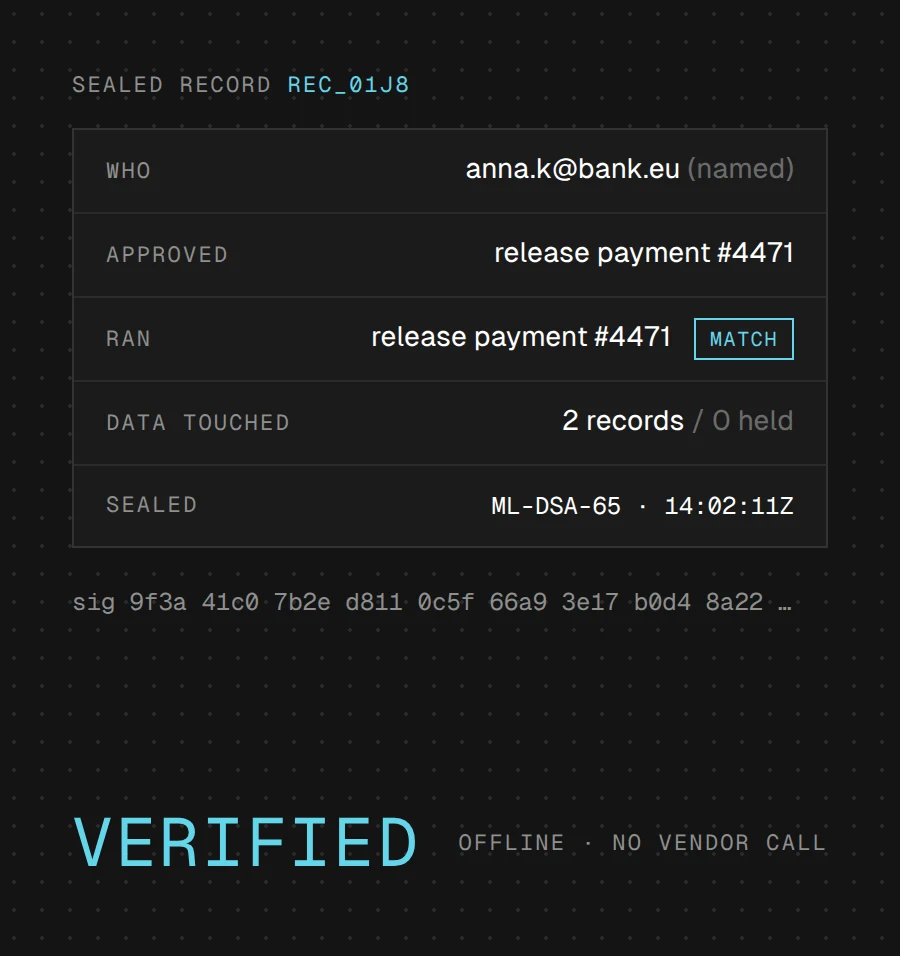
Athena does not write a better log. It produces a sealed record, and the difference is in every property above.
First, the binding. Before an agent acts, Athena captures what was approved: the operation, its inputs, the data it was allowed to touch. When the agent executes, the executed action is bound to that approval inside the same record. The approve step and the execute step are not two nearby log lines. They are one object, and you cannot present the executed half without the approval it came from.
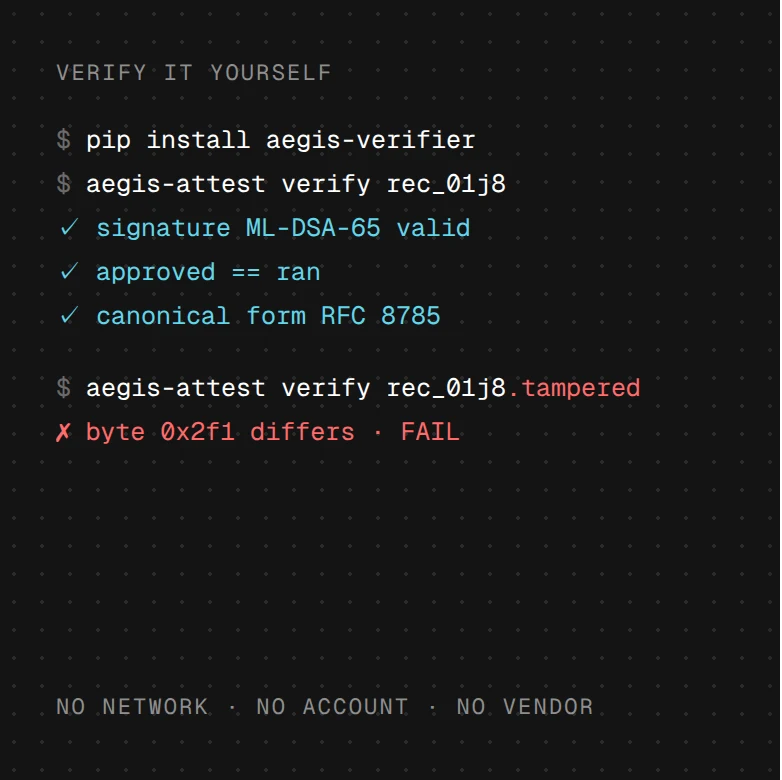
Second, the seal. The record is put into a canonical form using RFC 8785 (JSON Canonicalization Scheme), so the same bytes are produced from the same content on any machine, in any language. Athena computes a digest of those bytes and signs it with ML-DSA-65, the post-quantum signature scheme standardized in FIPS 204. Change one field, one value, one ordering, and the digest no longer matches and the signature no longer verifies.
Third, verification. To check a sealed record, a verifier canonicalizes it, recomputes the digest, and checks the signature against the public key. That is all. There is no call to Athena, no access to your systems and no trust required in the vendor who produced it, which includes us. This is a single-record proof: each sealed record stands on its own and is verified on its own.
A log says "here is what I did, trust me." A sealed record says "here is what I did, check it yourself, offline, and catch me if the bytes moved."
That property is what compliance and risk functions need. A sealed record is candidate evidence you can hand to an auditor, a regulator, or a counterparty under frameworks like DORA, ISO 42001, or SOC 2, in structured formats such as OSCAL. Athena does not issue legal opinions and does not grant certification. It produces a record whose integrity someone else can verify without taking your word for anything.
Test any accountability claim about your AI with one question: can an outsider verify this without access to our systems and without trusting us? If the answer is no, you have a log, however nicely it is formatted. A log is a good operational tool and a weak witness. When the action moves money or touches regulated data, you need a record whose integrity does not depend on the honesty of the thing that wrote it.